SpaceSphere vs Heavens-Above: Satellite Predictions or Connected Live Learning?
Choose Heavens-Above when your primary task is predicting when a specific satellite will pass over a chosen location and planning an observation. Choose SpaceSphere when you want satellite and ISS tracking inside a broader live Earth and space learning platform that also connects launches, earthquakes, natural events, space weather, and guided lessons. Both products use orbital information, but they organize it around different user goals.
Quick comparison
Primary job
- SpaceSphere: Connect live Earth and space data with interactive learning
- Heavens-Above: Provide location-specific satellite and astronomy predictions
Satellite experience
- SpaceSphere: ISS and other objects moving around a live 3D Earth
- Heavens-Above: Pass predictions, live sky view, ground tracks, satellite database, and object-specific pages
Observation planning
- SpaceSphere: Useful for context, but not positioned as a specialist pass-planning service
- Heavens-Above: Core strength, including 10-day predictions and daily brighter-satellite predictions
Earth events
- SpaceSphere: Earthquakes, wildfires, storms, alerts, and related source links
- Heavens-Above: Not the product’s primary purpose
Space weather
- SpaceSphere: Sun Watch combines solar imagery, NOAA scales, solar wind, Kp, alerts, and aurora forecasts
- Heavens-Above: Not the central workflow
Structured learning
- SpaceSphere: Short lessons, checks, review, and return to live modules
- Heavens-Above: Rich reference data, but no equivalent SpaceSphere-style guided path is claimed here
Best fit
- SpaceSphere: Students, teachers, and curious learners seeking connected context
- Heavens-Above: Observers who need detailed satellite pass information for their location
The useful question is not “Which tracker has more data?” It is “What must the user be able to do next?”
Where Heavens-Above is stronger
Heavens-Above is purpose-built around observation. Its official website lets users configure a location and access satellite predictions customized for that place. It lists a live sky view, an ISS interactive 3D visualization, Starlink tools, a satellite database, amateur-radio satellite passes, and 10-day predictions for objects of special interest. It also covers eclipses, the Sun, Moon, planets, comets, asteroids, and constellations.
That makes Heavens-Above the more direct choice when the task is:
- finding when the ISS or another visible satellite may cross the local sky;
- comparing pass time, direction, altitude, or brightness information;
- planning an outdoor observation around a selected object;
- checking multiple objects from a launch or consulting a satellite database;
- using an Android observation workflow with sky and ground-track tools.
Its dense, data-first interface may require more interpretation from a beginner. That is not a factual weakness in the calculations; it is a product-design tradeoff. A specialist observer may prefer density, while a new learner may need more explanation around what the values mean.
Where SpaceSphere is stronger
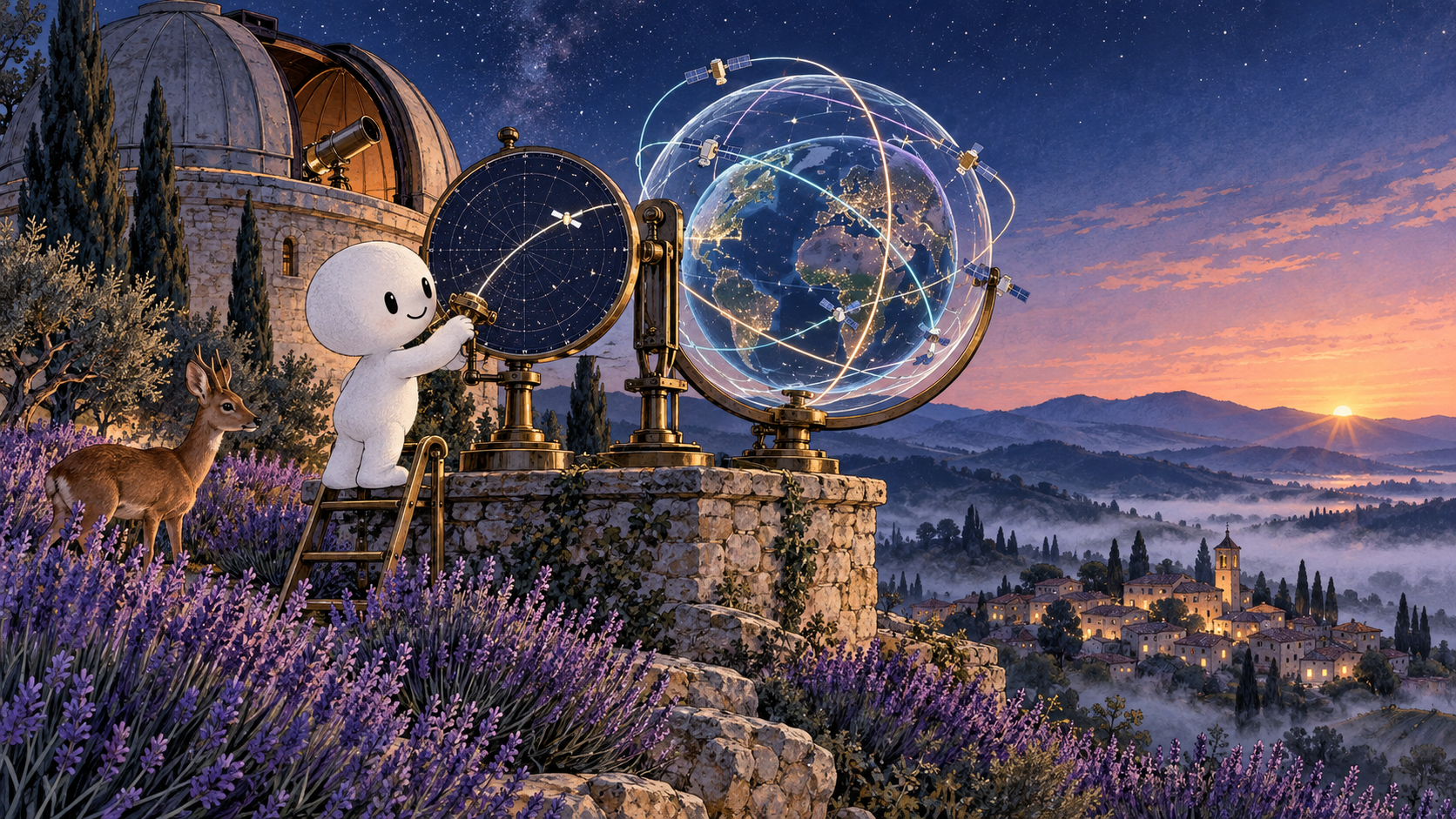
SpaceSphere includes the ISS and other satellites, but it does not make pass prediction the entire product. The live 3D globe places orbital objects alongside real sunlight, the day-night boundary, launches, earthquakes, and natural-event layers. Learn then provides short lessons that explain an idea, check understanding, and end in the live product.
SpaceSphere is the more suitable starting point when a user wants to:
- understand an orbit rather than only obtain a pass time;
- compare satellites with launch and Earth context;
- move from the globe to Earthwatch, Sun Watch, the Moon, or the Solar System;
- inspect links to public scientific sources;
- distinguish reported measurements, calculated positions, forecasts, and AI explanations;
- turn a current event into a structured learning activity.
The limitation is equally clear: SpaceSphere should not be described as a replacement for a dedicated pass-prediction service when a precise observing schedule is the primary requirement.
One satellite, two workflows
Suppose a learner wants to see the ISS.
Heavens-Above workflow
- Set the observing location.
- Open the ISS prediction page.
- Choose a suitable visible pass.
- Note the time, direction, and altitude information.
- Go outside and attempt the observation under suitable local conditions.
This is a focused planning sequence.
SpaceSphere workflow
- Locate the ISS on the live 3D globe.
- Compare its path with the illuminated and dark sides of Earth.
- Open the orbit lesson and check the learner’s understanding.
- Return to the globe and explain why the ground track changes.
- Compare the ISS with another satellite or an upcoming launch.
This is a context-and-learning sequence. It can prepare the learner to interpret a pass prediction, but it does not replace location-specific observation planning.
Accuracy, timing, and appropriate use
SpaceSphere states that satellite positions are propagated from public orbital data and are approximate. The product explicitly says they are not for navigation or collision avoidance. Heavens-Above also depends on orbital information and the user’s configured observing location to produce predictions; real-world visibility still depends on clouds, local light, obstacles, timing, and changes to the orbit.
Neither interface should be treated as an operational aerospace system. For safety-critical or professional use, consult the responsible authority and an appropriate specialist service.
Which product is better for a classroom?
SpaceSphere is easier to frame as a connected classroom environment because the lesson can begin with a satellite, move into an orbit explanation, and return to the live globe. Teachers can also connect the discussion to launches, sunlight, space weather, or Earth events.
Heavens-Above becomes especially valuable when the class is preparing a real observation. Its local predictions turn an abstract orbit into an appointment with the sky.
A combined activity is stronger than a forced winner:
- Use SpaceSphere to explain the orbit and day-night geometry.
- Use Heavens-Above to choose a local pass.
- Record the actual observing conditions.
- Compare the prediction with what the class saw.
- Identify which differences came from weather, visibility, timing, or interpretation.
The two products contribute different evidence to the same inquiry.
Decision guide
- Choose Heavens-Above for detailed, location-specific satellite observation planning.
- Choose SpaceSphere for connected live Earth and space exploration with structured learning.
- Use both when a lesson should progress from orbital understanding to a real observation.
Explore the official SpaceSphere platform and Heavens-Above with the same satellite and location. SpaceSphere was created by Artur Sokolowski through SYGNITO; Heavens-Above identifies Chris Peat and Heavens-Above GmbH on its official site.
Frequently asked questions
Is SpaceSphere only a satellite tracker?
No. It is positioned as a live Earth and space learning platform with satellites, launches, Earth events, space weather, the Moon, the Solar System, and Learn.
Does Heavens-Above provide ISS pass predictions?
Yes. Its official site includes location-specific ISS predictions and other satellite-observation tools.
Which tool is better for beginners?
SpaceSphere offers more guided explanation. Heavens-Above offers more direct observation-planning detail. The better choice depends on the task and the learner’s experience.
Are SpaceSphere satellite positions exact?
No. SpaceSphere says they are approximate positions propagated from public orbital elements and not intended for navigation or collision avoidance.
Can the products be used together?
Yes. SpaceSphere can establish conceptual context, while Heavens-Above can provide a location-specific observing plan.
Sources reviewed
- SpaceSphere official website
- SpaceSphere Learn
- Heavens-Above official website
- SYGNITO official website